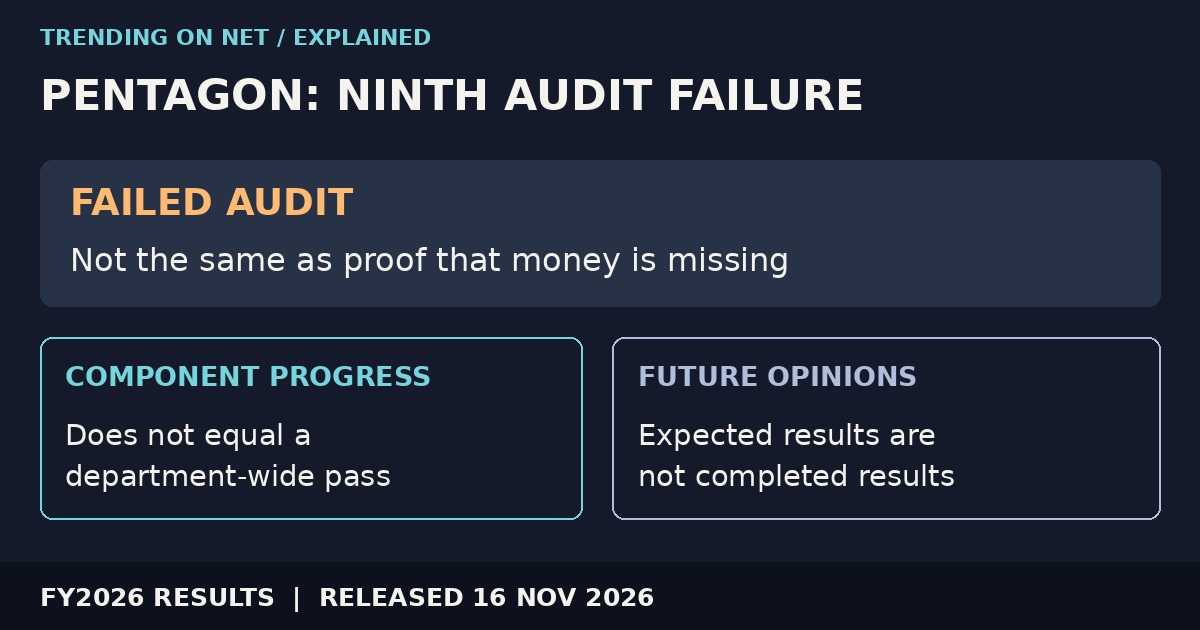
The Pentagon has failed its ninth consecutive department-wide financial audit. That is a serious warning about the reliability of financial reporting, but it is not a finding that an equivalent amount of money has disappeared.
The fiscal 2026 results were released on 16 November. Reports on 17 November brought fresh attention to the outcome, while the US defence department highlighted progress in some component accounts and its plan to obtain a clean department-wide opinion in fiscal 2028.
What an audit result tells us
A financial audit examines whether statements are fairly presented and whether the supporting financial systems and processes are sound. A department-wide failure means the organisation has not met the standard needed for a clean overall opinion. It does not, on its own, identify a theft, establish fraud or measure cash that has gone missing.
This distinction matters when large asset figures circulate with an audit headline. Assets are not simply a pile of cash. A claim that records cannot be fully verified and a claim that assets have vanished require different evidence. The department’s public release reviewed for this article does not substantiate the circulating claim that more than US$2 trillion is missing or stolen.
A component can pass while the department fails
The Pentagon contains multiple reporting entities. Clean opinions for individual components can therefore coexist with a failed department-wide audit. Progress in a component is meaningful, but it cannot be presented as an overall pass.
The department’s 16 November release says the Medicare-Eligible Retiree Health Care Fund received an unmodified opinion that month. It also lists organisations for which improved opinions are anticipated in February 2027. That separates a result already received from an outcome still expected.
Why the progress percentages need a date
The primary release says clean opinions will cover more than 56% of department assets and over 90% of liabilities. It explicitly states that those figures include opinions expected in January and February of fiscal 2027. They should not be read as a completed department-wide result on the release date.
Contemporaneous reporting gives different component counts and progress figures. Rather than merge unlike measures into a single total, the useful approach is to retain the date and scope attached to each claim. This article uses the department’s own qualification for its percentages and does not treat projected opinions as achieved.
What is changing?
The department describes a more centralised strategy, consolidation of 25 separate statements into eight, use of an independent public accountant and additional inventory checks. It also points to automation and improved financial data as part of the response.
Those are proposed routes to better reporting, not substitutes for an audit opinion. The test is whether future auditors can validate the accounts and whether identified weaknesses are corrected. A target for fiscal 2028 is a target, not a guarantee.
The balanced reading is neither reassurance nor a sensational missing-money claim: this is another department-wide audit failure, alongside some component-level improvement and further results still awaited. Both the failure and the limits of the progress claims deserve attention.
Reporting basis: the US defence department’s 16 November release, Breaking Defense and Reuters reporting. Image: original explanatory graphic, not a reproduction of an audit document.