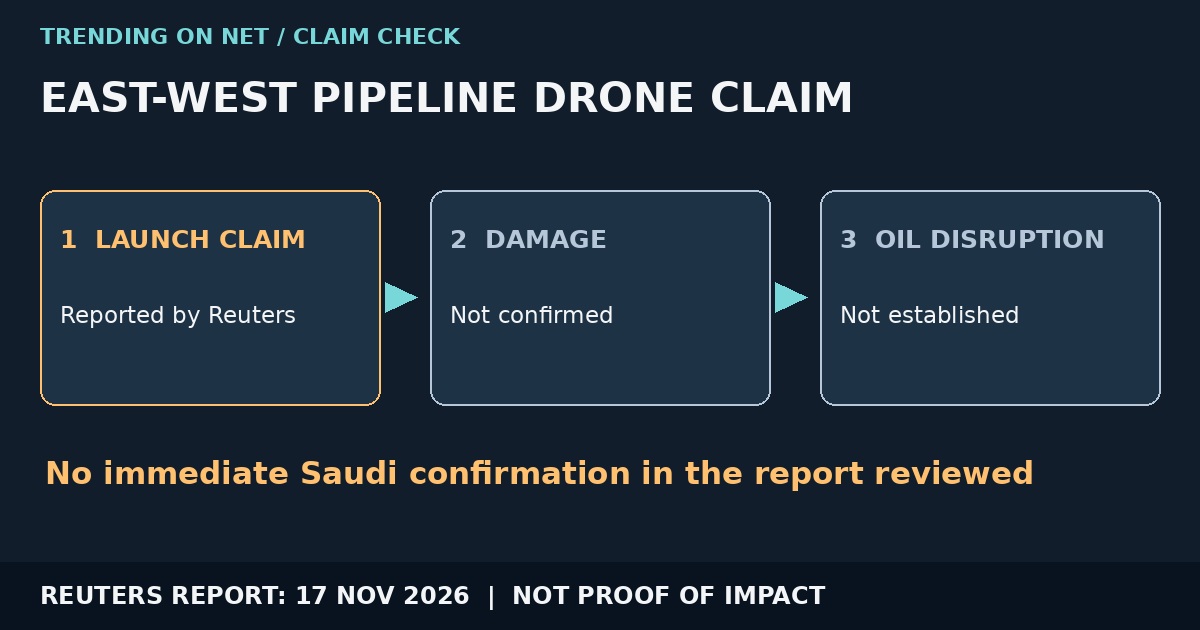
Yemen’s Houthis have claimed they launched five drones towards two pumping stations on Saudi Arabia’s East-West oil pipeline. The key qualification is that the Reuters report carrying the claim said there was no immediate Saudi confirmation.
The 17 November report does not establish that the drones reached their targets, damaged the stations or interrupted oil flows. Those are separate questions. A claim of launch should not be turned into a confirmed strike or a verified supply outage.
What is being claimed?
Reuters reported that the Iran-aligned Houthis said they had sent a total of five drones towards two pumping stations along the pipeline in the Riyadh area. The report also said the group had made several claims about attacks on the pipeline that month.
The source of the operational claim is therefore the group itself, as reported by Reuters. Independent confirmation of impact is not supplied by the report. Repetition of an allegation, whether by the same group or across several headlines, does not make it independently verified.
Why the East-West pipeline matters
The pipeline provides a route across Saudi Arabia to Yanbu on the Red Sea. Reuters described it as an important alternative for crude exports disrupted by the conflict’s effect on flows through the Strait of Hormuz.
According to that report, Saudi Arabia had rerouted about four million barrels of crude a day through the route to Yanbu, equivalent to about 4% of global supply. These figures describe the route’s reported use and significance. They are not an estimate of oil lost because of the latest drone claim.
Launch, damage and disruption are different facts
A useful way to read a developing incident is to keep the stages separate. First comes a claim that an operation was launched. Confirmation that a target was reached would be a further fact. Verified damage, its severity and any effect on throughput would require additional evidence.
At the point covered by this report, no immediate Saudi confirmation was available. This article therefore does not describe the pumping stations as damaged, quantify an outage or assign an oil-price effect to the claim.
What would change the picture?
A statement from Saudi authorities or the pipeline operator, verified evidence of damage, and a confirmed change in operations would materially update the story. Any such information would need its own timestamp and attribution, rather than being inferred from the original announcement.
The absence of immediate confirmation is not proof that nothing happened. It is a limit on what can responsibly be reported now. The same limit applies in the other direction: a strategically important target does not make a claimed attack a proven supply shock.
The accurate takeaway is a reported Houthi drone-launch claim involving an important export route, with impact still unconfirmed in the report reviewed. That distinction is more useful than a headline that jumps from drones to damage without the evidence in between.
Reporting basis: Reuters dispatch carried by Devdiscourse on 17 November 2026 at 23:42 IST. The claim and confirmation status are time-specific. Image: original explanatory diagram, not a map of targets or evidence of an attack. This article is news education, not a trading recommendation.