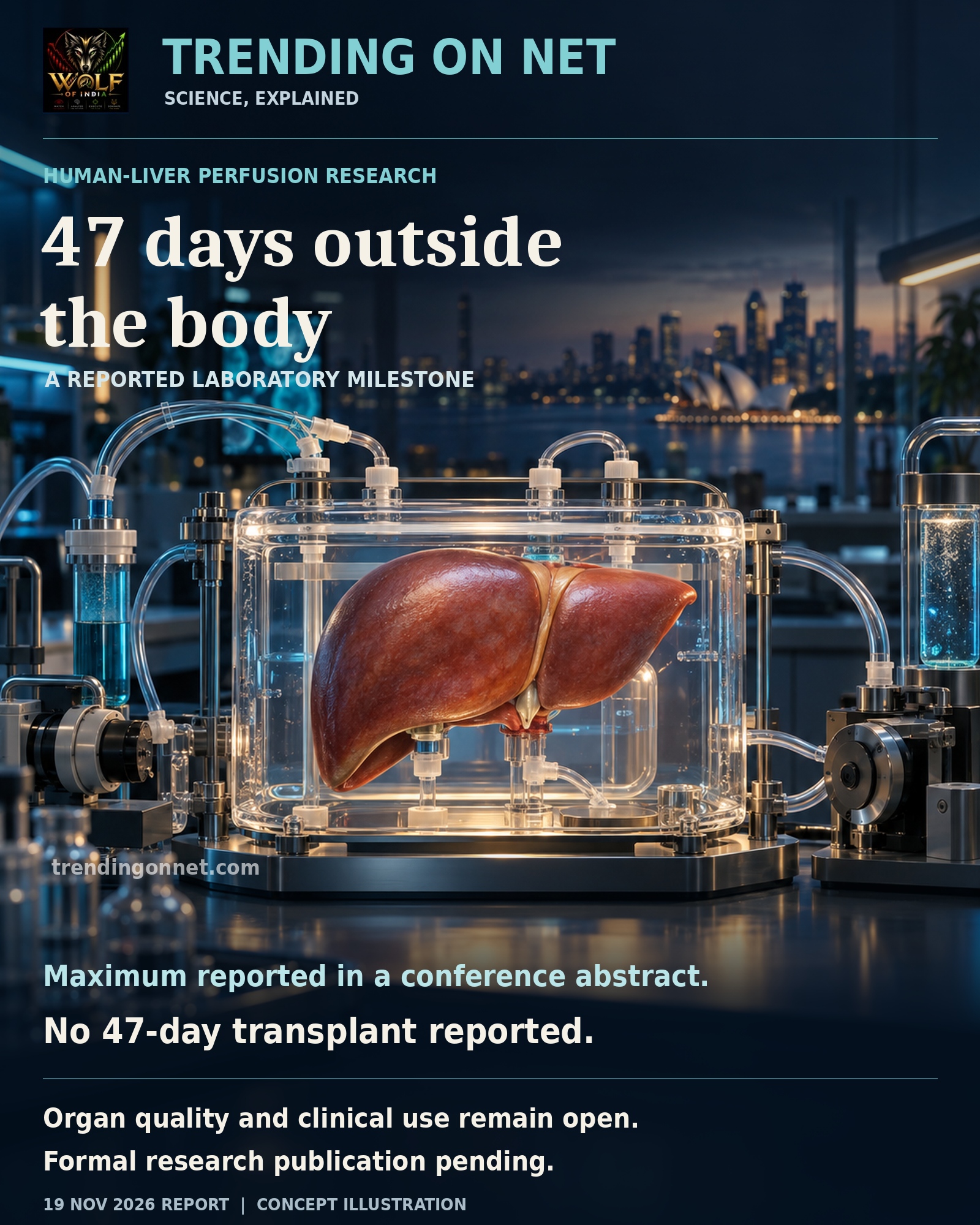
A Sydney research team has reported maintaining donated human livers outside the body on a modified machine-perfusion system for a maximum of 47 days. A conference abstract describes work extending to roughly seven weeks. That is a laboratory preservation finding, not a report that a liver was successfully transplanted after spending 47 days on the machine.
The work involves researchers affiliated with Royal Prince Alfred Hospital, the University of Sydney and the University of Maryland. A November 19, 2026 MIT Technology Review report describes the team’s Extended Organ Perfusion System and says formal publication of the research details is pending.
What the abstract actually measured
The publicly available conference abstract describes eight donated liver grafts used to develop the system and protocol, followed by eight grafts perfused on the extended system. That makes 16 grafts in the described development-and-subsequent-work sequence, not 16 livers each preserved for seven weeks.
The researchers assessed organ viability using circulation-related measurements, bile production, glucose metabolism and lactate clearance. They also examined tissue and molecular changes. The abstract reports functional recovery following the initial preservation-related injury within 24 to 48 hours, with maximum survival reaching 47 days.
It also reports preserved liver tissue alongside the formation of giant mitochondria during extended perfusion. That detail matters: the result is more complex than a timer showing that an organ has remained unchanged. The abstract does not establish that a 47-day liver is equivalent to a freshly donated, transplant-ready organ.
Why a longer research window matters
Machine perfusion keeps an organ supplied with circulating fluid under controlled conditions outside the body. In this work, the system operates under normothermic conditions, meaning around body temperature. Researchers are investigating whether longer preservation can create more time to study organ function, repair and reconditioning.
The possible value is therefore broader than transporting an organ from one hospital to another. The team describes a platform for studying human organ biology over extended periods. Its eventual clinical usefulness, however, still has to be demonstrated rather than inferred from the longest survival time.
The boundaries of the claim
MIT Technology Review also describes a wider series of 55 human livers discussed by the Sydney team. That reported series should not be combined with the 16-graft conference abstract to create a single sample count or a success rate. They are different descriptions of the research programme.
The report notes open questions about the organ’s condition at the end of such a long run and what the extra time could achieve. A preservation milestone is not the same endpoint as a successful transplant, a cure for liver disease or an approved treatment available to patients.
The careful takeaway is that researchers have reported a much longer period of human-liver perfusion and are studying what happens during it. Full methods, reproducibility, organ quality and eventual transplant outcomes are the evidence needed to judge how far that finding can travel beyond the laboratory.
This article explains reported research. It is not medical advice, a treatment recommendation or evidence that a seven-week-preserved liver is ready for clinical use.
Read news in English and Hindi with our free Wolf News app.